


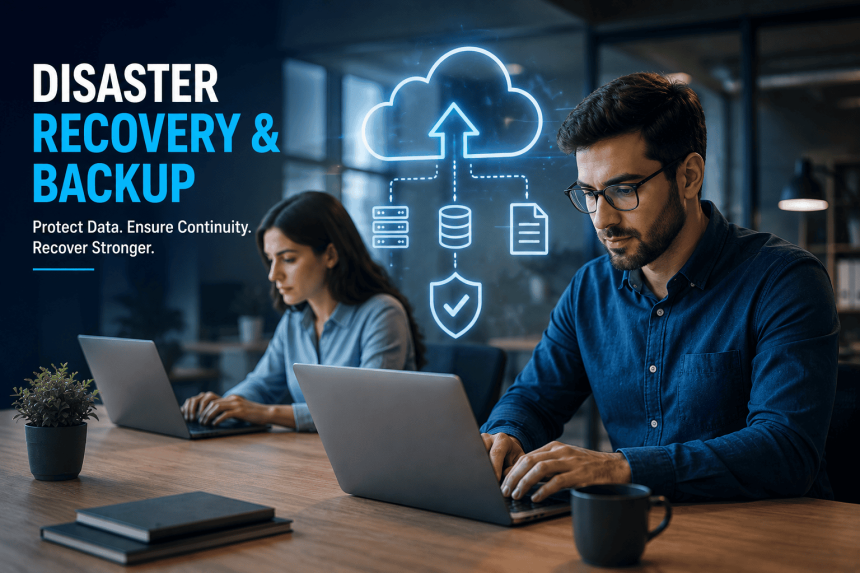
Data loss, ransomware attacks, hardware failures, accidental deletions, and server outages can severely impact business operations. Modern organizations require strong backup and disaster recovery solutions to protect critical business data and maintain operational continuity.
Disaster Recovery and Backup solutions help businesses:
- protect sensitive information,
- recover systems quickly,
- minimize downtime,
- and ensure business continuity during unexpected incidents.
What is Disaster Recovery & Backup?
Backup solutions help organizations create secure copies of business data.
Disaster Recovery (DR) focuses on restoring:
- applications,
- servers,
- systems,
- and business operations
after cyberattacks, hardware failures, disasters, or outages.
Together, backup and disaster recovery help businesses recover quickly from disruptions.
Key Disaster Recovery & Backup Features
1. Automated Backup
Modern backup solutions can automatically back up:
- files,
- databases,
- emails,
- virtual machines,
- cloud applications,
- servers.
Automation reduces the risk of human error.
2. Cloud Backup
Cloud backup stores business data securely in remote cloud infrastructure.
Benefits include:
- remote accessibility,
- improved redundancy,
- offsite protection,
- scalable storage,
- reduced hardware dependency.
3. Ransomware Protection
Backup solutions help businesses recover encrypted files after ransomware attacks.
Advanced platforms offer:
- immutable backups,
- malware scanning,
- backup isolation,
- suspicious activity detection.
This significantly improves cyber resilience.
4. Instant Recovery
Businesses can quickly restore:
- files,
- applications,
- servers,
- emails,
- virtual machines.
Fast recovery helps minimize operational downtime.
5. Disaster Recovery Orchestration
DR solutions help automate recovery workflows.
Organizations can restore:
- critical systems,
- infrastructure,
- cloud workloads,
- business applications
during disasters or outages.
6. Hybrid Backup Support
Modern businesses use hybrid environments combining:
- on-premise servers,
- cloud infrastructure,
- SaaS applications.
Backup platforms can protect all environments centrally.
7. Data Replication
Data replication continuously copies business data to secondary locations.
This improves:
- availability,
- redundancy,
- failover readiness,
- recovery speed.
8. Backup Monitoring & Reporting
Admins can monitor:
- backup success rates,
- storage usage,
- failed backups,
- recovery status,
- security alerts.
This improves operational visibility.
9. Compliance & Retention Policies
Backup solutions help organizations meet compliance requirements through:
- retention policies,
- encryption,
- audit logs,
- secure storage.
This is important for regulated industries.
10. Microsoft 365 & Cloud App Backup
Many organizations assume cloud platforms automatically provide complete backup protection.
Backup solutions help protect:
- Microsoft 365,
- Exchange Online,
- OneDrive,
- SharePoint,
- Teams,
- Google Workspace data.
This ensures long-term recoverability.
Benefits of Disaster Recovery & Backup Solutions
Reduced Downtime
Fast recovery minimizes operational disruption.
Better Cyber Resilience
Businesses can recover from ransomware and cyber incidents more effectively.
Improved Business Continuity
Critical systems remain recoverable during emergencies.
Protection Against Human Errors
Deleted or modified files can be restored quickly.
Compliance Readiness
Businesses can meet industry compliance and audit requirements.
Common Causes of Data Loss
Organizations commonly face data loss due to:
- ransomware attacks,
- accidental deletions,
- hardware failures,
- server crashes,
- insider threats,
- power failures,
- natural disasters,
- cloud sync errors.
Backup and DR solutions reduce these risks significantly.
Who Needs Disaster Recovery & Backup?
These solutions are important for:
- enterprises,
- SMEs,
- healthcare organizations,
- financial institutions,
- educational institutes,
- manufacturing companies,
- IT firms,
- government organizations.
Any business relying on digital data requires backup protection.
Popular Backup & Disaster Recovery Solutions
Widely used solutions include:
- Veeam Backup
- Acronis
- Microsoft Azure Backup
- Datto
- Veritas
- Commvault
- Rubrik
- Druva
Disaster Recovery vs Backup
| Feature | Backup | Disaster Recovery |
|---|---|---|
| Purpose | Data Copy | Full Business Recovery |
| Recovery Scope | Files/Data | Systems & Operations |
| Downtime Reduction | Moderate | High |
| Infrastructure Recovery | Limited | Complete |
| Automation | Basic | Advanced |
Both are important parts of a business continuity strategy.
Final Thoughts
Disaster Recovery and Backup solutions are essential for modern business operations.
As organizations increasingly depend on digital infrastructure, protecting data and ensuring recoverability becomes critical.
Modern backup and DR solutions help businesses:
- reduce downtime,
- recover from cyberattacks,
- protect sensitive information,
- improve operational resilience,
- and maintain business continuity.
For businesses handling critical systems and customer data, backup and disaster recovery are no longer optional — they are a core part of cybersecurity and operational strategy.