



As businesses increasingly rely on cloud platforms, email communication, remote work, and digital collaboration, protecting sensitive business information has become more important than ever.
Data Loss Prevention, commonly known as DLP, helps organizations prevent unauthorized access, accidental sharing, and intentional leakage of sensitive data.
Modern DLP solutions help businesses secure:
- customer data
- financial records
- confidential documents
- intellectual property
- employee information
- compliance-sensitive data
What is Data Loss Prevention (DLP)?
Data Loss Prevention (DLP) is a cybersecurity solution that monitors, detects, and protects sensitive information from being:
- leaked
- copied
- shared
- downloaded
- or accessed improperly
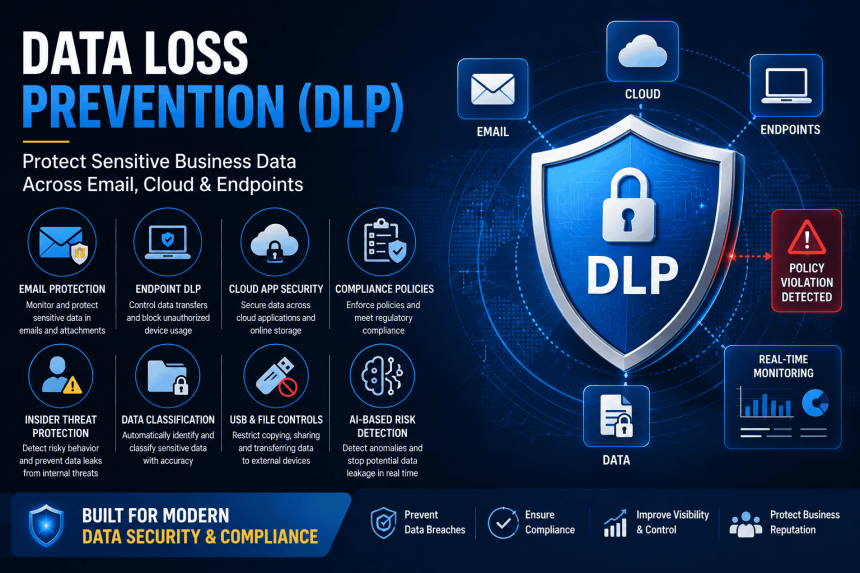
DLP solutions apply security policies across:
- endpoints
- cloud apps
- collaboration tools
- storage platforms
- networks
Key Data Loss Prevention Features
1. Sensitive Data Identification
DLP systems can automatically identify:
- credit card data
- financial records
- government IDs
- healthcare records
- confidential business documents
This helps organizations classify and protect sensitive information.
2. Email DLP Protection
Email remains one of the biggest sources of accidental data leaks.
DLP solutions help:
- scan outgoing emails
- detect sensitive attachments
- block unauthorized sharing
- apply encryption automatically
This reduces risks from accidental employee mistakes.
3. Endpoint Data Protection
Endpoint DLP protects devices such as:
- laptops
- desktops
- USB devices
- external drives
Businesses can restrict:
- file copying
- USB transfers
- unauthorized uploads
- screen captures
- local downloads
4. Cloud Application Security
Modern businesses use:
- Microsoft 365
- Google Workspace
- Dropbox
- OneDrive
- Teams
- SharePoint
DLP helps monitor and secure data across cloud applications.
5. Policy-Based Access Controls
Admins can define rules such as:
- block sharing of confidential files
- restrict external email sharing
- prevent unauthorized printing
- stop uploads to personal cloud storage
Policies can be customized department-wise.
6. Compliance & Regulatory Support
DLP helps businesses comply with:
- GDPR
- HIPAA
- ISO 27001
- PCI DSS
- internal compliance requirements
This is important for regulated industries.
7. Real-Time Monitoring & Alerts
Security teams receive alerts when suspicious activity occurs.
Examples include:
- mass downloads
- unusual sharing
- external transfers
- unauthorized access attempts
This improves threat visibility.
8. Insider Threat Protection
DLP helps reduce risks from:
- disgruntled employees
- accidental data exposure
- malicious insiders
- unauthorized sharing
This is increasingly important for hybrid work environments.
9. Data Classification
Modern DLP platforms can automatically label data as:
- confidential
- internal
- public
- sensitive
This helps organizations apply security policies more effectively.
10. Integration with Microsoft 365 & Security Platforms
Popular DLP solutions integrate with:
- Microsoft Purview
- Microsoft 365
- Endpoint management tools
- SIEM solutions
- Cloud security platforms
This improves centralized security management.
Benefits of Data Loss Prevention
Better Data Security
Sensitive business information remains protected across devices and cloud platforms.
Reduced Risk of Data Breaches
DLP reduces accidental and intentional data leaks.
Improved Compliance
Businesses can meet security and compliance requirements more effectively.
Enhanced Visibility
Security teams gain better visibility into how data is accessed and shared.
Stronger Remote Work Security
DLP helps secure hybrid and remote work environments.
Who Needs Data Loss Prevention?
DLP is useful for:
- financial organizations,
- healthcare companies,
- IT companies,
- educational institutions,
- legal firms,
- enterprises,
- government organizations,
- businesses handling sensitive customer data.
Popular DLP Solutions
Widely used DLP platforms include:
- Microsoft Purview DLP
- Symantec DLP
- Forcepoint DLP
- Trellix DLP
- Digital Guardian
- Endpoint Protector
Common Data Loss Risks Businesses Face
Organizations commonly face risks such as:
- employees emailing confidential files externally,
- accidental sharing in Teams or cloud apps,
- USB data copying,
- ransomware attacks,
- unauthorized downloads,
- unsecured personal devices.
DLP solutions help minimize these risks significantly.
Final Thoughts
Data Loss Prevention (DLP) is now a critical part of modern cybersecurity strategy.
As businesses continue adopting cloud platforms, hybrid work, and digital collaboration tools, protecting sensitive information becomes increasingly important.
DLP helps organizations:
- secure business data,
- improve compliance,
- reduce insider threats,
- strengthen endpoint security,
- and improve visibility into data movement.
For businesses handling confidential or compliance-sensitive information, DLP solutions provide essential protection against modern cyber risks.